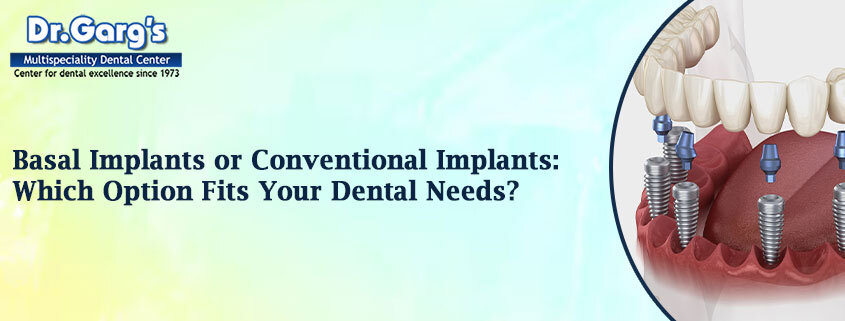
Replacing missing teeth involves more than choosing an implant and scheduling a procedure. The condition of the jawbone, gum health, number of missing teeth, treatment goals, and expected timeline can all influence which implant approach is appropriate. Two options that patients commonly compare are basal implants and conventional dental implants.
Understanding the difference between basal implants vs conventional implants can help you have a more informed discussion with an implant dentist before deciding on treatment.
Understanding Basal Implants
Basal implants are designed to obtain support from denser areas of the jaw, particularly cortical or basal bone. The treatment approach is different from conventional implant placement and may be considered in selected patients with significant bone loss or other limitations for standard implant treatment.
According to the information provided on the treatment page, basal implant treatment can be used in situations where conventional implant placement may present challenges, including reduced bone availability. The page also describes immediate loading approaches in which a fixed prosthesis may be provided soon after implant placement.
Potential advantages of basal implants
Depending on the patient’s clinical situation, the approach may offer:
- Treatment options for certain cases involving substantial bone loss
- The possibility of avoiding some bone-grafting procedures in selected cases
- Faster provisional tooth replacement in appropriate cases
- Options for patients who have experienced previous implant treatment difficulties
However, suitability should always be established through a clinical examination and appropriate imaging.
How Conventional Dental Implants Work
Conventional dental implants are the more established implant system used extensively for replacing individual or multiple missing teeth. They are generally placed into the available jawbone and allowed to integrate with the surrounding bone before the definitive restoration is fitted.
Unlike many basal systems, conventional implants commonly use a two-piece design consisting of the implant and abutment. Treatment timing varies according to bone quality, implant stability, healing, and whether additional procedures are necessary.
For appropriately selected patients, conventional implants provide a widely used approach for functional and aesthetic tooth replacement.
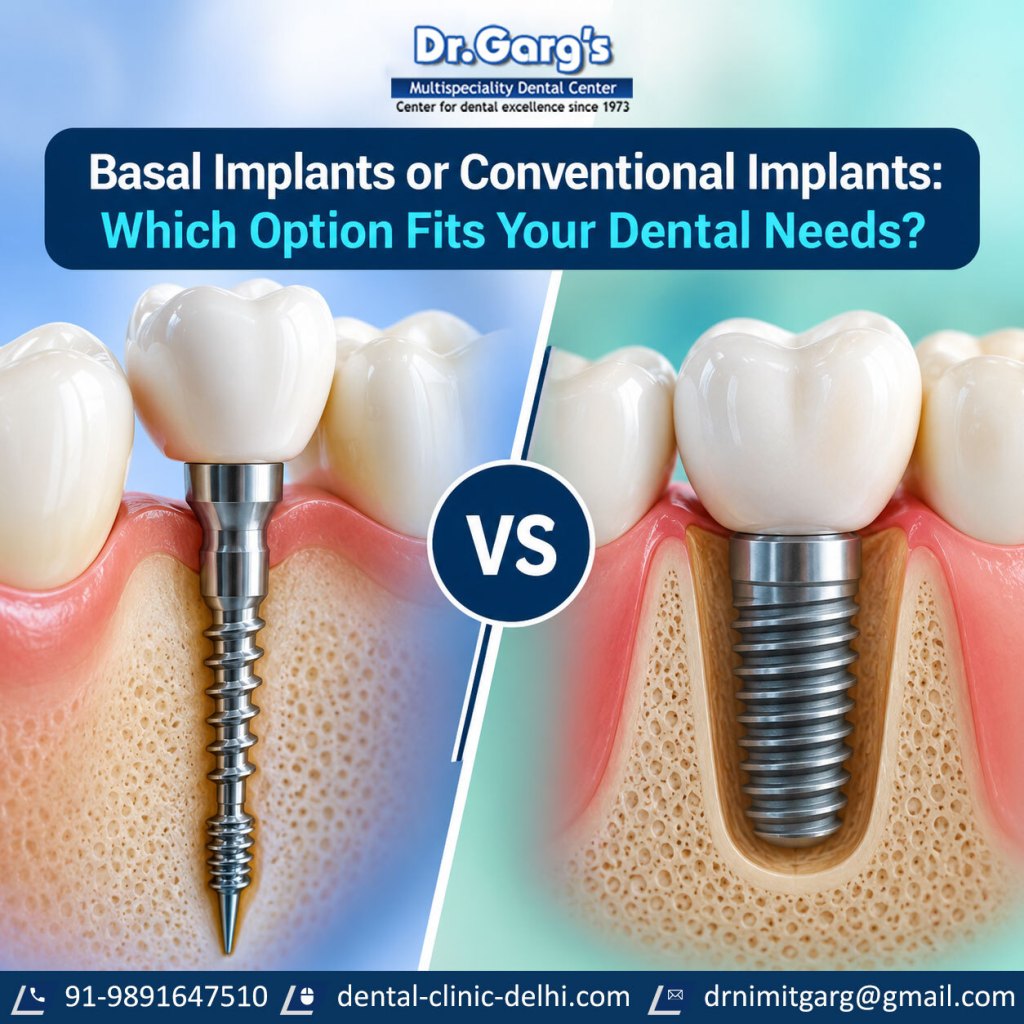
Basal Implant vs Conventional Implant: Key Differences
| Factor | Basal Implants | Conventional Dental Implants |
|---|---|---|
| Primary support | Cortical/basal bone | Available alveolar jawbone |
| Treatment approach | May allow immediate loading in selected cases | Commonly involves an integration/healing period |
| Bone augmentation | May not be required in some cases | May be recommended when bone volume is inadequate |
| Implant design | Often single-piece | Commonly two-piece |
| Typical use | Selected patients with challenging bone conditions | Broad range of single and multiple tooth replacement cases |
The distinction is not simply about which implant is “better.” The appropriate choice depends on the patient’s anatomy, oral health, restorative requirements, and treatment objectives.
Which Is Better: Basal or Conventional Implants?
There is no universal answer to basal implants or conventional implants. A patient with significant bone loss may require a different strategy from someone with adequate bone volume and healthy periodontal tissues.
It is also important not to assume that a shorter treatment timeline automatically means a better treatment. Evidence on immediate loading of dental implants shows that outcomes depend substantially on appropriate patient selection and primary implant stability. Recent systematic-review evidence has found immediate loading can perform comparably to conventional loading for selected single-implant cases, while other analyses have reported differences in failure risk for particular treatment situations.
Why an Individual Implant Assessment Matters
Before deciding between basal implants and conventional implants, an implant dentist should evaluate factors such as:
- Available bone volume and density
- Gum and periodontal health
- Number and location of missing teeth
- Existing infections or dental conditions
- Previous implant or grafting history
- Desired treatment timeline
- Final restoration and aesthetic requirements
This assessment helps determine whether a basal implant approach, conventional implant treatment, or another restorative solution is appropriate.
Making the Right Implant Decision
Patients researching basal implant vs conventional implant options should focus on suitability rather than choosing a treatment solely because it promises faster results or avoids additional procedures. Both approaches have different indications, techniques, and restorative considerations.
A detailed consultation with an experienced implant dentist can help you understand your bone condition, available treatment options, expected timeline, and long-term restorative requirements before proceeding.
For anyone considering conventional dental implants or exploring basal implant treatment, a personalized clinical assessment is the right starting point.
 Dr. Garg’s Multispeciality Dental Center